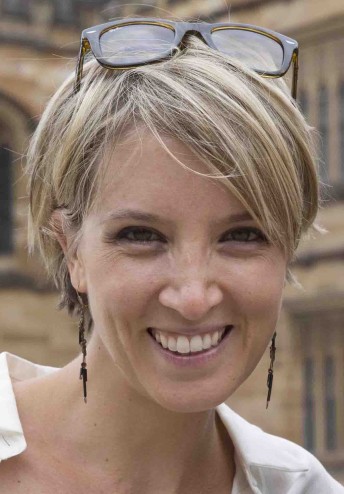
Hi I’m Juliet Bennett, a Research Fellow at the Sydney Centre for Healthy Societies, Faculty of Arts and Social Sciences, and Charles Perkins Centre, at The University of Sydney. My research draws connections across scales and subjects to activate co-creative and systemic interventions for personal and planetary wellbeing.
For the last two years I have had the great privilege of working with esteemed academics Alex Broom, David Raubenheimer and Katherine Kenny on SCHS and CPC’s joint research program on The Social Life of Food and Nourishment applying critical social theory to systems of food production and consumption.
My PhD developed a new inroad to process philosophy and a tool for to assist in its application for sustainable futures. This thesis showed how nesting “static thinking” within “process thinking” connects relational worldviews, contextual economics, and participatory politics. Together these help to mitigate the global systemic crisis – for which global inequality and climate change are its most urgent symptoms. My first book, based on this research, is entitled “Reimagining Peace through Process Philosophy: An Integrative Transformation to Address the Global Systemic Crisis.”
I also have an MPhil and MA in Peace and Conflict Studies, through which I sought to understand structural violence with a focus on themes of narratives, religion and education. I have taught undergraduate units in Narratology and Peace Studies at Lenoir Rhyne University in North Carolina, and postgraduate units in Peace and Conflict Studies at The University of Sydney.
Previously I worked at Sydney Policy Lab as Collaborative Research Manager, applying community-led research and policymaking methods for improved social outcomes. I also spent five years as Executive Officer and Acting Director of Sydney Peace Foundation organising the annual Sydney Peace Prize. These experiences have encouraged me to connect traditional academic research with applied policy research, and communicate findings for diverse audiences.